
What Is Investing and Why Does It Matter?

Simple Definition of Investing
Investing simply means putting your money into something today with the hope that it will grow in the future. Instead of keeping money idle in your wallet or bank account, you use it to buy things that can increase in value like stocks, real estate, or even a small business.
Think of it this way: planting a seed. You don’t eat the seed right away. You put it in the ground, take care of it, and over time it grows into a tree that gives you fruits year after year. Investing works the same way you give up using money now so it can multiply later.
Difference Between Saving and Investing
Saving and investing often get mixed up, but they’re not the same thing. Saving is about keeping your money safe usually in a bank account so you can use it later. It doesn’t grow much, but it’s secure.
Investing, on the other hand, involves some risk because you’re putting money into opportunities that could grow or lose value. The reward is that investing usually gives much higher returns than saving. For example:
- If you save $1,000 in a bank with 1% interest, after a year you’ll have $1,010.
- If you invest the same $1,000 in stocks that grow by 8% annually, after a year you’ll have $1,080.
The difference may look small in one year, but over 10 or 20 years, the gap becomes massive.
This is how billionaires think they choose to invest instead of just saving and waiting for their money to grow little by little. One example of someone who thinks this way is Elon Musk, whom you all know. Let’s discuss this together. I also think like this just kidding.”
Why People Invest Instead of Just Saving
People invest because they want their money to work for them. Simply saving is safe, but it doesn’t beat inflation the rising cost of living. If bread costs $2 today and $3 ten years from now, your savings lose power over time.
Investing helps you stay ahead of inflation, build wealth, and reach big goals like buying a house, sending kids to school, or retiring comfortably. In short, saving keeps you safe today, but investing secures your future.
The Core Principles of Smart Investing
Risk vs. Reward Explained
Every investment carries some level of risk. Stocks can go up and down, property markets can crash, and businesses can fail. But generally, the higher the risk, the higher the potential reward.
Smart investors don’t just chase rewards they balance risk. For example, a college student might take higher risks in stocks since they have time to recover from losses, while someone close to retirement might prefer safer investments like bonds.
The Power of Compound Interest
Albert Einstein once called compound interest the “eighth wonder of the world.” It’s the idea that your money earns returns, and then those returns start earning returns themselves.
For example:
You invest $1,000 at 10% annual growth. After the first year, you have $1,100.
In the second year, you earn 10% on $1,100 not just $1,000 so now you have $1,210.
Over decades, this snowballs into huge growth without you adding anything more.
It’s like a snowball rolling down a hill, getting bigger and bigger with every turn.
Time in the Market vs. Timing the Market
A common mistake is trying to “time the market” buy when prices are low, sell when they’re high. The truth is, nobody can predict markets consistently, not even professionals.
What works better is time in the market staying invested for the long run. Historically, markets grow over time despite short-term ups and downs. If you had invested $10,000 in the U.S. stock market 30 years ago and simply left it there, it would be worth many times more today even with all the crashes in between.
In investing, patience usually beats prediction.
Investing isn’t only about putting money into markets; it’s also about investing in yourself. This article highlights the most valuable skills to learn in 2025 skills that could be the key to building a stable financial future.
Different Types of Investments You Can Make
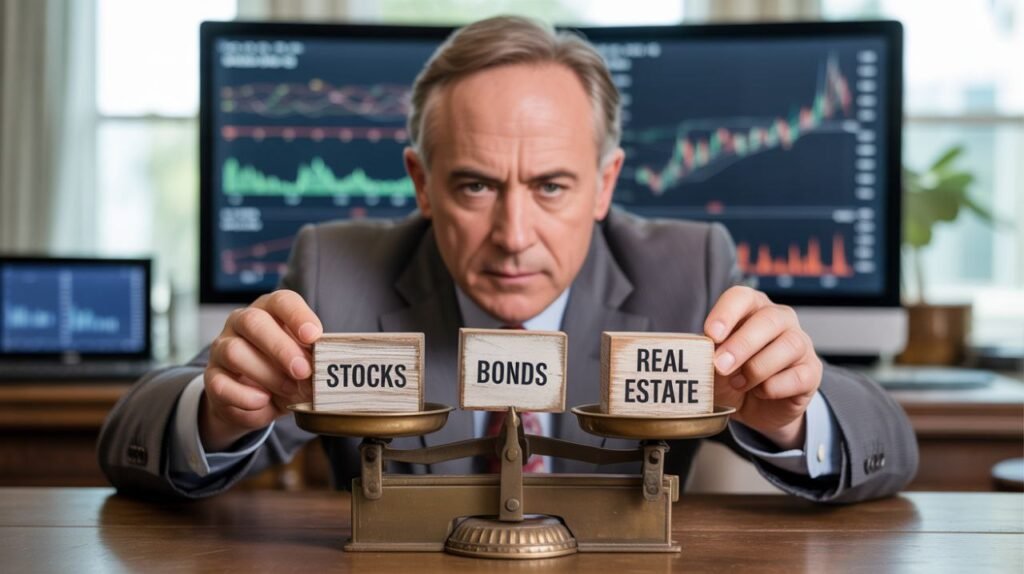
Stocks – Owning a Piece of a Company
When you buy a stock, you’re literally buying a piece of a company. If the company grows and becomes more valuable, your share grows too. If it struggles, you feel that loss as well.
For example, when I was younger, I used to hear about people who invested in companies like Apple or Amazon before they became giants. A single share bought in the 1990s could now be worth hundreds of times more. Stocks carry risk, but they’re also one of the fastest ways to build wealth over time.
investopedia a well-known website that provides detailed explanations on NPV, IRR, discount rate, and financial analysis.
Bonds – Lending Money for Returns
Bonds are like you lending money to governments or companies, and in return, they promise to pay you back with interest. They’re usually less risky than stocks, but the returns are smaller.
Think of it like this: when I loan a friend $100, and he promises to return $110 in a year, that’s similar to how a bond works except on a much larger and more formal scale. Bonds are popular with people who want steady income and less risk.
Real Estate – Property as an Investment
Real estate is about buying property houses, apartments, or land with the goal of making money from rent or price growth.
I still remember when a relative of mine bought a small piece of land on the edge of town. At that time, people thought it was a waste of money. Ten years later, the city expanded, and that land’s value multiplied by five. Real estate can be slow-moving, but it’s a solid way to build wealth.
Mutual Funds & ETFs – Diversified Investing
Not everyone has time to pick individual stocks or bonds. That’s where mutual funds and ETFs (Exchange-Traded Funds) come in. They let you invest in a collection of different companies or assets all at once.
It’s like going to a buffet instead of ordering just one dish you get a little bit of everything. This makes your risk lower because if one stock struggles, the others in the fund can balance it out.
Alternative Investments – Crypto, Gold, and More
Beyond the traditional options, there are alternative investments like cryptocurrencies (Bitcoin, Ethereum), gold, art, or even collectibles.
These can sometimes give huge returns, but they’re also very risky. For example, crypto has made some young people millionaires overnight, but it has also caused others to lose nearly everything. That’s why most experts suggest putting only a small percentage of your money in these areas, not all of it.
The cryptocurrency market is constantly evolving, and staying informed is crucial. This article summarizes the latest key updates that could significantly influence your investment decisions.
How to Start Investing as a Beginner
1. Setting Clear Financial Goals
Before you put any money into investing, you need to know why you’re investing. Are you saving for retirement? Buying a house? Funding your kids’ education? Clear goals guide your choices.
When I started, my first goal was simple: I wanted to build a fund that could cover my college fees. That goal shaped how much I invested and where I put my money.
2. Creating an Emergency Fund First
Investing is important, but life can be unpredictable. That’s why having an emergency fund at least 3–6 months of your living expenses saved is critical.
I’ve seen friends rush into investing without an emergency fund. When unexpected bills hit, they were forced to sell their investments at the wrong time. With an emergency fund, you can keep your investments safe while handling life’s surprises.
3. Choosing the Right Investment Platform or Broker
In today’s world, you don’t need to be on Wall Street to start investing. There are apps and online platforms where you can begin with just a few dollars.
The key is to choose a platform that is safe, easy to use, and fits your needs. For example, when I started, I picked a beginner-friendly platform that allowed me to invest small amounts while learning the ropes.
4. Starting Small but Staying Consistent
You don’t need thousands of dollars to begin. Even $20 or $50 a month can grow into something big over time if you stay consistent.
I personally began with tiny amounts because that’s all I could afford as a student. Over time, those small contributions added up and seeing the growth gave me motivation to keep going. Consistency matters far more than starting big.
Quantum computing is one of the most exciting frontiers in modern investment. If you want to discover how to tap into innovative opportunities, this guide offers expert strategies to get you started.
Common Mistakes New Investors Should Avoid

Investing Without Research
One of the biggest mistakes beginners make is jumping into investments without really understanding what they’re buying. I remember when I first started I bought shares in a company just because a friend told me “it’s going up.” A few months later, the stock crashed, and I realized I hadn’t even looked at what the company did.
Doing your own research isn’t about becoming an expert overnight, but at least knowing what you’re putting your money into. It’s like buying a car without checking if it has an engine you just don’t do it.
Chasing Quick Profits
The temptation to “get rich quick” is strong. I’ve been there seeing a stock or crypto coin shoot up and thinking, if I just put everything in, I’ll double my money tomorrow. But the reality is, what goes up quickly often comes down just as fast.
Chasing quick profits is like running after a bus you might catch it once or twice, but most of the time you’ll be left behind, out of breath. Long-term patience usually beats short-term gambling.
Ignoring Diversification
I learned the hard way what it means to put all your eggs in one basket. At one point, nearly all my investments were in a single tech company. When the market turned, I lost a big chunk of my portfolio in a single week.
Diversification means spreading your money across different assets stocks, bonds, real estate, even different industries. That way, if one thing struggles, the others can keep you afloat.
Emotional Investing – Fear & Greed
Markets move because people are emotional fear when prices drop, greed when prices rise. I’ve sold out of panic and regretted it, and I’ve bought into hype and regretted that too.
The best investors learn to control emotions. Think of investing like driving: if you slam the brakes every time a car passes by, you’ll never get to your destination. Staying calm and sticking to your plan matters more than reacting to every bump in the road.
Advanced Investing Strategies for Growth
Dollar-Cost Averaging (DCA)
This is a strategy I’ve personally used when I didn’t have a lot of money to invest at once. Instead of trying to time the market, I invested a fixed amount every month sometimes when prices were high, sometimes when they were low. Over time, it averaged out, and I built a solid portfolio without the stress of guessing.
It’s like filling a jar with coins every week. You don’t notice much at first, but after a few years, the jar is heavy.
Value Investing vs. Growth Investing
These are two different ways of thinking. Value investing is about finding companies that are undervalued—solid businesses that are “on sale.” Growth investing, on the other hand, is about betting on companies that are expected to grow rapidly, even if they look expensive today.
At one point, I tried both: buying a “cheap” stock that everyone ignored, and also investing in a fast-growing tech startup. Both taught me that no single strategy is perfect it depends on your risk tolerance and patience.
Dividend Investing for Passive Income
Dividend investing is one of my favorites. You buy stocks of companies that regularly pay out a portion of their profits to shareholders. Over time, those small payments add up and can even replace part of your income.
I still remember the first time I received a dividend payment it was only a few dollars, but it felt like free money. It’s a strategy many retirees use because it provides steady cash flow.
Index Fund Investing for Long-Term Wealth
If you don’t want the stress of picking individual stocks, index funds are a powerful option. They track the overall market, like the S&P 500, which means you own tiny pieces of hundreds of companies at once.
Warren Buffett himself has said that most people would be better off simply investing in index funds and holding them for decades. Personally, when I wanted peace of mind, I shifted a portion of my money into index funds it’s slow and steady, but very reliable.
How to Manage Risk While Investing

Diversification Across Assets
The old saying goes: “Don’t put all your eggs in one basket.” Warren Buffett has also stressed that diversification is key for most investors who aren’t professional stock pickers.
I learned this lesson when I put almost everything into tech stocks back in the day. When the sector dropped, so did my portfolio. Since then, I’ve spread investments across stocks, bonds, and even real estate. That way, if one sector struggles, the others balance things out.
Think of it like farming you wouldn’t only plant one crop, because if that crop fails, you lose everything. Spreading your seeds gives you a better chance of harvesting something no matter the season.
Asset Allocation Based on Age & Goals
How you invest should reflect your stage in life. A 25-year-old saving for retirement can afford more risk than a 60-year-old who’s about to retire. This is what’s called asset allocation deciding how much to put in stocks, bonds, or safer assets.
John Bogle, the founder of Vanguard, once said: “The most important decision you make is not what stock to buy, but how you allocate your assets.” Personally, when I was younger, I leaned heavier into growth stocks. Now, I balance it with safer assets because my financial goals have shifted.
Regular Portfolio Rebalancing
Even if you start with the perfect plan, markets move. Over time, one investment may grow faster than the others, throwing off your balance. Rebalancing means checking your portfolio regularly and adjusting it back to your original plan.
For example, if stocks rise sharply and suddenly make up 80% of your portfolio (when you only wanted 60%), you might sell some and move the money into bonds or cash. It’s like steering a car you don’t just hold the wheel straight forever, you adjust along the way to stay on the road.
The Future of Investing – What’s Next?
Impact of Artificial Intelligence on Investing
AI is transforming investing faster than most people realize. Today, algorithms can analyze millions of data points in seconds, spotting patterns humans would miss. Big firms already use AI to predict market movements, and everyday investors are beginning to benefit too.
Ray Dalio once noted: “He who lives by the crystal ball will eat shattered glass.” In other words, no prediction is perfect. But AI makes research faster, more accurate, and often less emotional. Personally, I’ve seen AI tools help cut through endless reports, summarizing risks and opportunities in ways that save me hours.
Sustainable & Ethical Investing (ESG)
Another powerful trend is sustainable investing, also called ESG (Environmental, Social, and Governance). This is about putting money into companies that not only make profits but also do good for the planet and society.
Younger generations especially care about this. For example, instead of buying shares in a company that pollutes heavily, many now prefer to invest in renewable energy companies or businesses that value fair labor. As Larry Fink, CEO of BlackRock, said: “Climate risk is investment risk.”
Global Trends Shaping the Next Decade
Investing doesn’t happen in a bubble it’s influenced by global events. Rising technology, shifting demographics, climate change, and even geopolitics all play a role.
For instance, the rise of Asia’s middle class has created huge opportunities in consumer markets. Meanwhile, digital currencies and blockchain are challenging how we think about money itself. One thing I’ve noticed personally: the investors who keep an eye on these global shifts often spot opportunities before the crowd does.
External Resources
investopdia.com a well-known website that provides detailed explanations on NPV, IRR, discount rate, and financial analysis.
corporatefinanceinstitute.com Offers professional online training and articles on investment appraisal and financial decision-making.
Hpr.com High-quality articles that cover strategic investment, risk management, and corporate finance.
worldbank.org Provides data and analysis on global markets and investment development.
Final Thoughts on Investing for Long-Term Success
Building Wealth Slowly but Steadily
Investing is not a race it’s more like planting a tree. You don’t expect fruit the day after planting the seed. You water it, protect it, and with time, it grows into something strong that can feed you for decades.
When I first started investing, I thought the key was finding that one “big win.” But experience taught me otherwise. The real wealth came not from quick gains, but from steady, consistent contributions month after month, year after year.
Think about it this way: if you put aside even a small amount every month, over time the effect of compound interest will surprise you. It’s not magic it’s mathematics working quietly in your favor.
Why Patience Is the Most Powerful Investment Tool
If I had to give only one piece of advice, it would be this: be patient. The market will rise and fall; that’s its nature. But those who stay the course, instead of panicking, are the ones who end up winning in the long run.
Warren Buffett, one of the most respected investors in history, once said: “The stock market is a device for transferring money from the impatient to the patient.” And he’s right. I’ve seen friends sell too quickly out of fear, only to watch prices recover later. The patient investor, however, learns to breathe, wait, and trust the process.
At the end of the day, investing is like having a parachute. You don’t always need it immediately, but when life takes an unexpected turn, it’s there to protect you. By starting todayeven small you give yourself and your family a softer landing in the future.
So my advice to you is simple: start now, stay consistent, and let time do the heavy lifting.
Hi Neat post There is a problem along with your website in internet explorer would test this IE still is the market chief and a good section of other folks will pass over your magnificent writing due to this problem
Thank you for pointing this out! 🙏 We truly appreciate your feedback. We’ll definitely look into the Internet Explorer issue to make sure everyone can enjoy a smooth experience on our site. Your support means a lot!
Simply wish to say your article is as amazing The clearness in your post is just nice and i could assume youre an expert on this subject Well with your permission let me to grab your feed to keep updated with forthcoming post Thanks a million and please carry on the gratifying work
Thank you so much for your wonderful words! 🌟 It’s truly encouraging to hear this. You’re more than welcome to subscribe and stay updated — I’ll continue sharing valuable content with readers like you in mind.
Your blog is a breath of fresh air in the often stagnant world of online content. Your thoughtful analysis and insightful commentary never fail to leave a lasting impression. Thank you for sharing your wisdom with us.
Your kind words truly mean the world to me! 💡 My goal has always been to provide refreshing and insightful content, and I’m so happy it resonates with you. Thank you for being part of this journey!
Simply desire to say your article is as surprising The clearness in your post is simply excellent and i could assume you are an expert on this subject Fine with your permission let me to grab your feed to keep up to date with forthcoming post Thanks a million and please carry on the gratifying work
Thank you for your honest feedback! 🙏 We’ll definitely review and polish our posts to ensure a flawless reading experience. It means a lot that you still enjoy the content and plan to come back!
obviously like your website but you need to test the spelling on quite a few of your posts Several of them are rife with spelling problems and I to find it very troublesome to inform the reality on the other hand Ill certainly come back again
Thank you for your honest feedback! 🙏 We’ll definitely review and polish our posts to ensure a flawless reading experience. It means a lot that you still enjoy the content and plan to come back!
Somebody essentially lend a hand to make significantly articles Id state That is the very first time I frequented your website page and up to now I surprised with the research you made to make this actual submit amazing Wonderful task
I’m so glad your first visit left a positive impression! 🌟 I put a lot of effort into research to ensure accuracy and value. Thank you for noticing — I’d love to have you visit again for more content!
Your blog is like a beacon of light in the vast expanse of the internet. Your thoughtful analysis and insightful commentary never fail to leave a lasting impression. Thank you for all that you do.
This truly warms my heart! 💖 Knowing that my writing can bring value and clarity in the vast ocean of content out there inspires me to keep going. Thank you for your continued support!